 MadCowTree Service
Emerald ash borer has killed huge numbers of ash trees in Illinois and Missouri. If you still have a living ash, it is worth asking whether treatment can protect it. If the tree is already badly declined, it is safer to take it down before the wood gets brittle. Estimates are free. Call 618-CUT-WOOD (618-288-9663).
What emerald ash borer looks like
Common signs are a thinning crown from the top down, D-shaped exit holes in the bark, woodpecker damage and bark splitting. The photos below show the exit holes and the S-shaped galleries the larvae leave under the bark.

Photo: Daniel Herms, The Ohio State University, Bugwood.org, CC BY 3.0, via Wikimedia Commons

Photo: Tom Brumbelow, U.S. Fish and Wildlife Service (Public domain), via Wikimedia Commons
How we treat ash trees
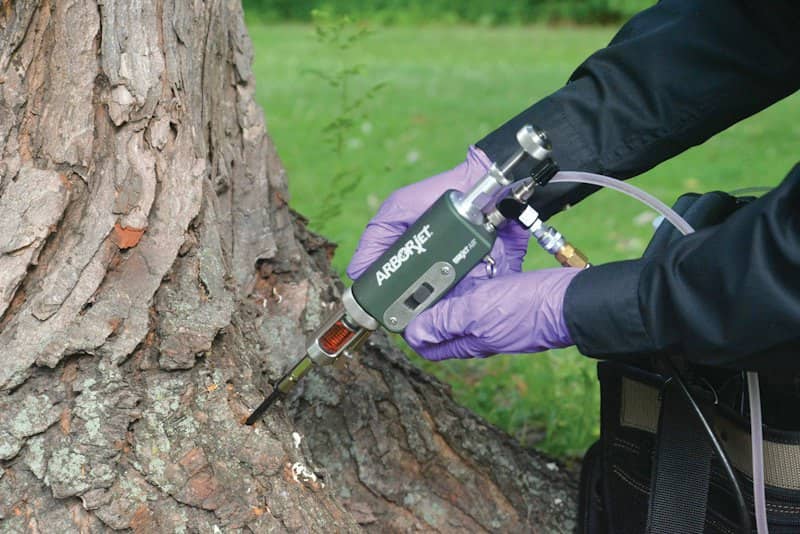
For trees that still have a fairly full canopy, we use trunk injection — a treatment method our arborists apply on the job, as in the photo on this page. We also prune out dead wood when that helps, and we will tell you honestly when removal is the better option. We are ISA Members and follow current arboriculture practice. We do not claim a tree is certified or guaranteed to survive.
When removal is the right call
Once an ash has been dead for a season or two, the wood gets brittle and it becomes harder and riskier to climb. Ash trees killed by emerald ash borer are a big share of our tree removal work in Madison County and north St. Louis County. We use a crane, bucket truck, chippers and a stump grinder when the job needs them, and we can grind the stump after.
For other tree diseases and pests — oak wilt, bagworms, scale and more — see tree health care.