 MadCowTree Service
Common problems we treat around Alton and St. Louis
Emerald ash borer (EAB)
This beetle has killed huge numbers of ash trees in Illinois and Missouri. Signs: thinning crown from the top down, D-shaped exit holes, woodpecker damage, bark splitting. Healthy ash trees can be protected with treatments. Trees that are already badly declined usually need to come down. See emerald ash borer treatment.

Photo: Tom Brumbelow, U.S. Fish and Wildlife Service (Public domain), via Wikimedia Commons
Oak wilt
A fungal disease that moves between oaks through root grafts and beetles. Red oaks can die within a season. Leaves wilt and brown from the edges in early summer. We help limit spread and time pruning to avoid it.

Photo: Joseph O'Brien, USDA Forest Service, Bugwood.org, CC BY 3.0 US, via Wikimedia Commons
Bagworms
The little brown bags on junipers, cedars, arborvitae and spruce are full of caterpillars. Left alone, they can strip an evergreen bare. Timing matters: treat in late spring/early summer when they’re small, or pick the bags off in winter.

Photo: Famartin, CC BY-SA 4.0, via Wikimedia Commons
Scale, aphids and mites
Scale, aphids and mites on maples, magnolias, euonymus and evergreens. The white cottony mass in the photo is cottony maple scale, a common one on maples.

Photo: WanderingMogwai, CC BY-SA 4.0, via Wikimedia Commons
Anthracnose
Anthracnose on sycamores and maples after wet springs. Leaves get dead blotches along the veins and the canopy can look thin until the tree puts out a new flush of leaves.

Photo: Clemson University — USDA Cooperative Extension Slide Series, Bugwood.org (Public domain), via Wikimedia Commons
Apple scab and cedar-apple rust
Apple scab and cedar-apple rust on crabapples. The yellow-orange spots in the photo are cedar-apple rust, which is common on crabapples around here.

Photo: Ronincmc, CC BY-SA 4.0, via Wikimedia Commons
Iron chlorosis
Iron chlorosis in pin oaks and other trees: yellow leaves with green veins, common in our alkaline soils.

Photo: Famartin, CC BY-SA 4.0, via Wikimedia Commons
Decay and cankers
Decay and cankers on stressed trees, including hypoxylon canker on oaks after drought. The silver-gray crust in the photo is hypoxylon canker on bark.

Photo: peterwchen, CC BY 4.0, via Wikimedia Commons
How a tree health visit works
We look at the whole tree: leaves, bark, root flare, soil, what’s been done around it (new driveway, grade changes, mulch volcanoes). Then we tell you what we think is going on, what the treatment options are, and whether the tree is worth treating. Sometimes the honest answer is that removal is the better use of your money, and we’ll tell you that too.
Treatments we use
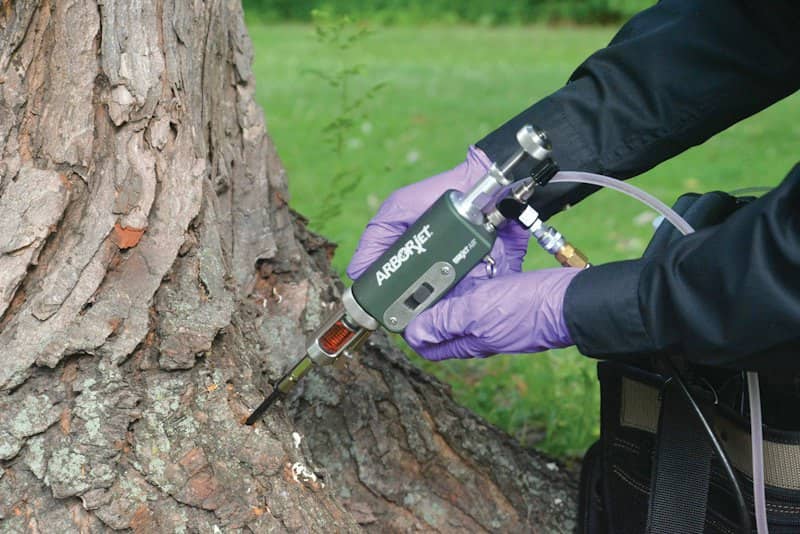
Depending on the problem: targeted insecticide or fungicide treatments, trunk injections for borers, deep-root fertilization where the soil is poor, pruning out infected or dead wood, mulching and watering plans, and cabling or bracing for weak limbs. We’re ISA Members and follow current arboriculture practice.
Catch it early
Most tree problems are much cheaper to fix early. If something looks off, snap a few photos (the whole tree, a close-up of the leaves, the bark and the base of the trunk) and send them with the form, or call 618-CUT-WOOD (618-288-9663).
Where we do tree health care
From our shop in Alton we serve 66 towns across Illinois and Missouri, including Godfrey, Edwardsville, Granite City, Collinsville, Jerseyville, St. Louis, Florissant, St. Charles and the rest of our service area.
Qualified customers can pay over time with 0% APR financing for up to 24 months through Wisetack. See financing options and terms.